


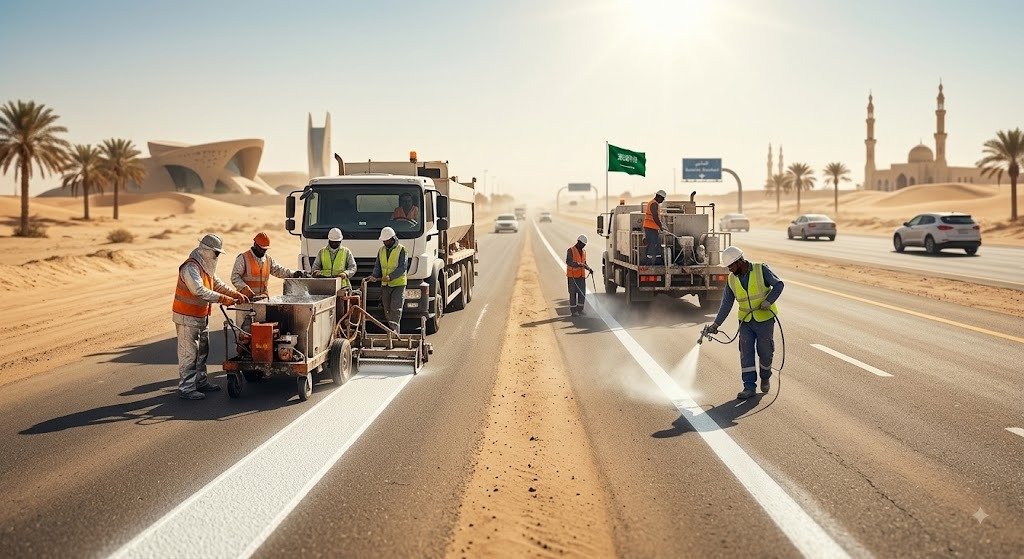
 Road Marking Companies in Saudi
Eight months after a compound in Riyadh was repainted, the parking bay lines had already gone patchy. The paint was not cheap. The applicator was not careless. The problem was the choice of material — cold paint on a heavily trafficked concrete surface, in a climate where the pavement surface can exceed 60°C in summer.
That decision is made early, usually on price, and it determines whether the lines last one year or five.
This article explains the practical difference between thermoplastic and cold applied paint, where each one genuinely performs in Saudi conditions, and what to check before you commit to either.
What actually separates the two materials
Cold applied paint is a liquid — solvent-based or water-based — applied by spray and left to dry. Application is quick, equipment is simple, and the surface is usually reopened to traffic within 30 to 60 minutes. Film thickness is thin, typically well under a millimetre.
Thermoplastic is a solid resin compound, melted at roughly 180–200°C and applied hot by screed or spray. It cools and bonds within minutes, forming a layer several millimetres thick. Glass beads are dropped onto the surface during application, and more beads are pre-mixed into the material itself, so reflectivity continues as the surface wears.
The real difference is not chemistry. It is thick. A thick, bonded layer resists tyre abrasion and sand scouring in a way a thin film cannot.
How Saudi conditions change the answer
Three factors here are harsher than in most markets.
Surface temperature. Cold paint can soften on hot asphalt, picking up dust and losing definition. Thermoplastic is already a heat-processed material and holds its form.
UV exposure. Intense sunlight fades pigment. Yellow degrades faster than white in both materials, but the thicker thermoplastic layer retains visible colour longer simply because there is more of it.
Sand and dust. Fine airborne sand acts as a continuous abrasive. It is the reason lines here often fail through erosion rather than peeling.
Add heavy vehicle traffic on industrial routes and the durability gap widens considerably.
Where each material makes sense
Thermoplastic suits:
- Highways, main roads and junctions
- Industrial estates and logistics yards with heavy axle loads
- Pedestrian crossings, arrows and legends requiring high night visibility
- Any surface where closing the road again soon is expensive
Cold paint suits:
- Temporary or phased marking during construction
- Layouts likely to change — parking reconfiguration, event marking
- Some indoor and covered areas
- Concrete surfaces where a thermoplastic-compatible primer is not viable
- Budget-constrained projects where planned repainting is acceptable
Neither is universally better. A logistics facility might correctly use thermoplastic on the access road and cold paint inside the covered yard.
The comparison, honestly
| Thermoplastic | Cold paint | |
| Initial cost | Higher | Lower |
| Typical service life | Several years | Roughly a year on trafficked surfaces |
| Night visibility | Better retained | Declines as surface beads wear |
| Application speed | Slower, needs heated equipment | Fast |
| Removal / change | Difficult | Straightforward |
| Cost over five years | Usually lower | Usually higher once repaints are counted |
Compare whole-life cost, not the quotation. Two repaints plus two traffic closures often exceed one thermoplastic application.
The factor that outweighs both
Surface preparation determines more of the outcome than material choice.
Markings fail early when applied over dust, laitance, oil, moisture, or fresh asphalt that has not cured. New asphalt needs curing time before permanent marking; laying thermoplastic too early risks poor bond. Concrete usually needs a primer.
A contractor who quotes without asking about surface age, condition or cleaning method is quoting for paint, not for road line marking that lasts.
Questions worth asking before you award
- Which material do you recommend for this surface, and why?
- What surface preparation is included in the price?
- What glass bead specification and application rate will you use?
- What line thickness will be achieved?
- Can you provide material data sheets and conformity documentation?
- What is the expected service life on our traffic loading?
Answers with specifics indicate a road lining contractor who has done this work. Vague answers indicate otherwise.
Common mistakes
- Choosing on price without comparing service life
- Marking new asphalt too early
- Skipping bead specification, so lines look fine by day and vanish at night
- Using one material across an entire site regardless of loading
- Marking during high humidity or on damp surfaces
Key takeaways
- Thermoplastic lasts longer under heat, UV, sand and heavy traffic
- Cold paint remains sensible for temporary, changeable or low-traffic areas
- Whole-life cost usually favours thermoplastic on trafficked surfaces
- Glass beads determine night visibility — specify them
- Preparation, timing and application discipline decide the result more than material brand
Working with Manycon
Manycon delivers road marking and surface coating works across Saudi Arabia from our base in Riyadh, alongside our wider construction and fire protection scope.
We assess the surface before recommending a material, because the same specification does not suit an industrial access road and a covered parking area. If you are planning marking works and want an honest view on which material fits your site, we are happy to carry out a site survey and advise.
Manycon Saudi : +966 56 562 7900
Frequently Asked Questions
Which lasts longer in Saudi Arabia, thermoplastic or cold paint?
Thermoplastic. Its greater thickness resists tyre abrasion, sand erosion and UV degradation far better than a thin paint film, particularly on trafficked roads.
Is thermoplastic more expensive overall?
It costs more per application but usually less across five years, because cold paint on a trafficked surface typically needs repainting roughly annually, each time with labour and traffic disruption.
Can thermoplastic be applied to concrete?
Yes, but concrete normally requires a suitable primer for adhesion. Applying directly to unprimed concrete risks early debonding.
Why do markings look bright by day but disappear at night?
Night visibility comes from glass beads reflecting headlight beams. If beads were omitted, under-applied, or have worn away, the line stays visible in daylight and effectively vanishes after dark.
How long should new asphalt cure before marking?
It varies with mix design, thickness and weather. The surface must be sufficiently cured and free of residues before permanent marking — confirm timing with your paving contractor rather than assuming a fixed period.
Can old markings be removed?
Cold paint is relatively easy to remove. Thermoplastic requires mechanical grinding or hydro-blasting, which can leave surface scarring. Where layouts may change, this is a genuine argument for paint.
What should I check when selecting a road marking company in Saudi Arabia?
Ask how they assess the surface, what preparation is included, which bead specification they apply, what line thickness they guarantee, and whether they can supply material documentation.
