


 Fire Proofing Service in Saudi
Introduction
Walk into any finished building in Riyadh, Dammam or Jubail and you can see the fire safety systems straight away. Sprinkler heads in the ceiling. Fire alarm panels near the entrance. Extinguishers on the wall.
What you cannot see is the part that holds the building together during a fire.
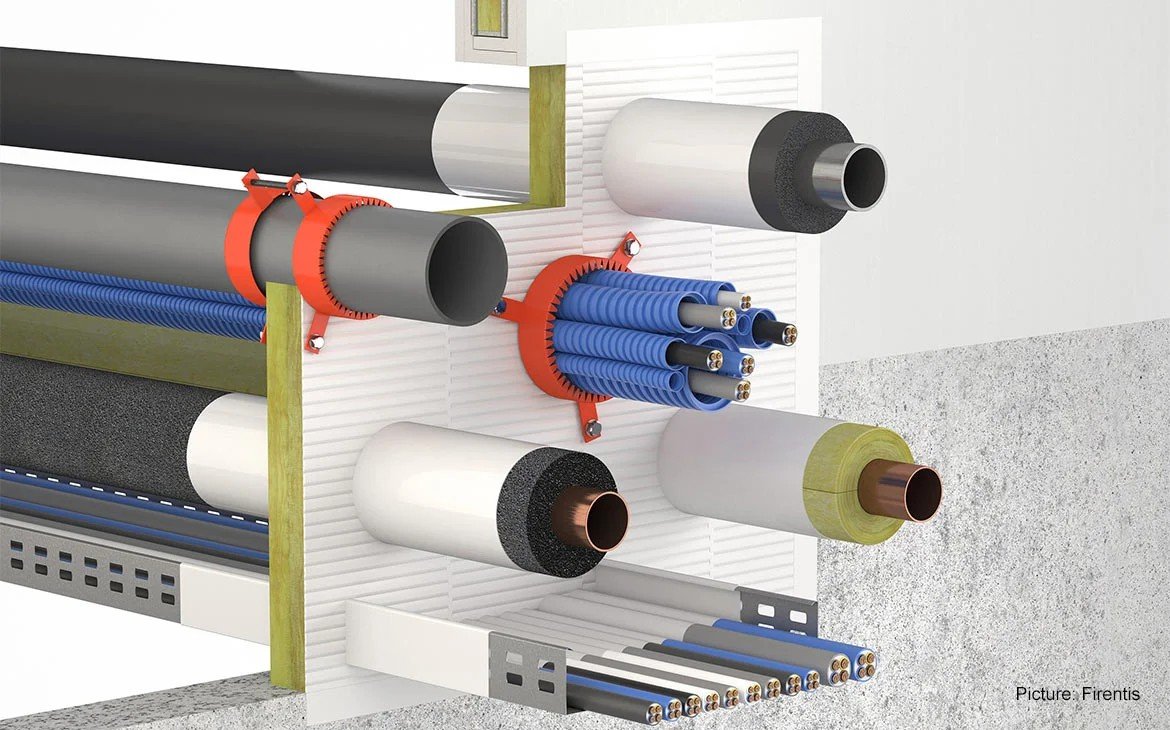
Above the ceiling tiles and inside the walls, there are hundreds of holes. Every cable, pipe, duct and cable tray has to pass through a wall or a floor slab to reach the next room. Each one of those holes is a gap in a fire-rated barrier. If those gaps are not sealed correctly, fire and smoke move from one room to the next in minutes, and the fire-rated wall on the drawing becomes a fire-rated wall in name only.
This is what passive fire protection deals with. It is quiet, hidden work, and it is one of the most common reasons a completed building sits waiting for approval instead of opening for business.
In this guide we explain, in simple terms, what the Saudi Fire Code SBC 801 asks for, how Civil Defense approval works through the Salamah system, where projects usually go wrong, and what a proper Fire Protection company should be giving you. If you are a project engineer, MEP consultant, main contractor or facilities manager looking for Fire Protection Services in Saudi, this is the practical picture.
Understanding Passive Fire Protection and Why It Matters
Fire protection has two sides, and both are needed.
Active fire protection reacts to a fire. Detectors sense it, alarms warn people, sprinklers and gas suppression systems fight it. These systems need power, water or a signal to do their job.
Passive fire protection does not react to anything. It is built into the structure and it works simply because it is there and because it was installed correctly. It contains the fire in the room where it started and keeps the building standing long enough for people to escape and for Civil Defense teams to enter safely.
Passive fire protection covers four main types of work:
1. Firestopping Sealing service penetrations — cables, pipes, ducts, cable trays and busbars — where they pass through fire-rated walls and floors, so the rating of the barrier is restored.
2. Linear joint and perimeter seals Sealing head-of-wall joints, movement joints, and the gap between a curtain wall and the edge of the floor slab. This last one is missed on tower projects more often than any other item.
3. Structural fireproofing Applying intumescent or cementitious coatings to structural steel so it keeps carrying load for a set period instead of softening early.
4. Fire-rated barriers and enclosures Rated board systems, duct protection and shaft linings that form the compartment itself.
Concrete and steel both have limits. Concrete spalls under sustained heat. Unprotected steel loses a large part of its strength well before it reaches the temperatures of a developed fire. Passive protection buys the time that every evacuation plan depends on. That is why serious Fire Protection Services always start here, not with equipment supply.
What SBC 801, the Saudi Fire Code, Requires
The Saudi Fire Code (SBC 801) sets the minimum fire safety requirements for buildings and facilities in the Kingdom, covering fire prevention, fire protection and life safety. It is based on the International Fire Code and adapted to local construction practice and regulation. It is published by the Saudi Building Code National Committee at sbc.gov.sa.
For passive fire protection, the code deals directly with fire-resistive construction, protection of structural elements, penetration protection, protection of door and window openings, and duct protection. It also carries a dedicated section on spray-applied fire-resistant materials and intumescent fire-resistant materials.
Two points matter more than anything else here.
First, ratings belong to tested systems, not to products. A sealant tube is not fire-rated on its own. What carries a rating is a complete tested arrangement — the correct substrate, the correct penetrating item, the correct gap size around it, the correct depth of material, the correct backing. Change any one of those and the test result no longer applies to your installation. SBC 801 refers to international test standards such as ASTM E814, UL 1479 and ASTM E119, and to EN 1366 where a European-tested product is proposed. Your submittal is judged against those listings.
Second, always check the current revision. SBC 801 has gone through more than one edition. Submittals get rejected for quoting an old version. Download the live document from sbc.gov.sa rather than using a PDF that has been forwarded around in a WhatsApp group.
There is also a difference many submittals get wrong. The F-rating is how long a firestop resists the passage of flame. The T-rating adds a limit on how much the temperature can rise on the cold side of the seal. Where combustible material may sit against the far face of the wall, the specification often calls for both. Answering only the F-rating is a common reason for a returned submittal.
Civil Defense Approval and the Salamah Process
Meeting the code is one thing. Proving it to the authority is another, and this is where projects lose time.
Fire safety approval in Saudi Arabia is handled by the General Directorate of Civil Defense. Salamah is the digital portal through which Civil Defense services are delivered to companies and investors, turning licence issue and renewal into digital processes. Engineering consultancy offices and technical services offices working in fire prevention and protection register for accreditation through the same portal.
The practical meaning is simple: your compliance is a record, not an opinion. Drawings, product approvals, inspection results and maintenance certification all sit in one traceable place. A verbal approval on site carries no weight if the file does not support it.
Industrial projects add another layer. The High Commission for Industrial Security (HCIS), under the Ministry of the Interior, provides oversight to sectors including petroleum, petrochemical, electricity, water, gas, mining, chemical and metal manufacturing, and ports. Asset owners then apply their own standards on top — Aramco projects follow SAES requirements, and most large operators maintain approved vendor and approved product lists.
If your site is in Jubail, Yanbu or Ras Al Khair, or connected to an Aramco asset, confirm which authority applies at tender stage. Finding out at inspection stage is expensive.
A submission that passes review normally contains:
- Approved shop drawings showing every rated barrier and every penetration
- Product data sheets with current third-party listings and SASO conformity documents
- A system schedule linking each penetration type on site to a specific tested system
- Method statements and risk assessments for each work type
- Installer training certificates for the actual operatives, not only the company
- Signed, dated, photographed inspection records referenced to drawing locations
- Dry film thickness records per steel member for fireproofing
- Labels on completed seals showing system reference, date and installer
- As-built drawings showing final penetration positions
- A maintenance and re-inspection regime carried into the O&M manual
Point 10 is the one owners forget. Passive protection is not finished at handover. Every future fit-out, cable pull or plant replacement breaks a seal that someone has to reinstate.
Where Projects Commonly Fail on Site
These are not unusual engineering problems. They are sequencing and paperwork problems, and they repeat on project after project.
The seal does not match any tested system. One sealant used across dozens of different configurations, none of which appear in the manufacturer’s tested library. It looks complete. It is not certifiable.
New penetrations made after sign-off. The IT contractor pulls one more cable through a finished seal in week 40 and nobody records it. The seal is now void and the as-built is wrong. A permit-to-penetrate procedure, enforced from first fix, prevents this at almost no cost. Fixing it after handover costs a great deal.
Fireproofing thickness taken on trust. Intumescent coatings achieve their rating at a specified dry film thickness for a given steel section factor. A member coated to 80% of required thickness does not give 80% of the protection time — the relationship is not linear. Wet film readings during application and DFT readings after cure, logged per member, are the only defensible record. Saudi conditions make this harder: high ambient and surface temperatures affect cure and film build, and application often has to move to early morning.
The evidence pack is assembled at the end. This is the single biggest cause of delay. Inspectors ask what was installed, where, by whom, to which listing, and on what date. Rebuilt from memory in the final week, it will not stand up. Built weekly, it is routine.
Compartment logic broken by late design changes. A wall gets moved, a riser gets relocated, a ceiling void gets shared between two compartments. Unless the fire strategy is revisited, the building no longer matches the approved drawings.
Key Points to Remember
- Passive fire protection contains fire and keeps the structure standing. It works without power, water or a signal.
- Ratings belong to tested systems, not to products. The installation must match the tested arrangement exactly.
- Check the current revision of SBC 801 before submitting anything.
- Know whether your specification needs an F-rating only, or an F-rating and a T-rating.
- Civil Defense approval through Salamah is document-driven. Build your evidence pack from day one.
- Industrial sites may also fall under HCIS and operator standards such as Aramco SAES.
- Fireproofing must be recorded by dry film thickness, member by member.
- Use manufacturer-trained installers and keep their certificates on file.
- Label every completed seal and update the as-builts.
- Passive protection needs maintenance. Every later penetration must be reinstated.
Benefits of Contacting Us
Getting a specialist involved early changes the shape of the project. Here is what that gives you.
Problems found before an inspector finds them. A compliance gap review on a live project identifies missing systems, wrong configurations and documentation gaps while they are still cheap to correct.
Submittals that match tested systems. Each penetration type on your project mapped to a specific listing, so the consultant approves the package instead of returning it.
One accountable party across the scope. Firestopping, fireproofing, rated boarding and testing handled together, rather than split between subcontractors who each assume someone else covered the gap.
Documentation built as the work proceeds. Inspection records, photographs, DFT logs and as-builts produced weekly, so the handover pack already exists when it is needed.
Trained installers on site. Certificates available for the operatives actually doing the work, which is a contractual requirement on most serious projects.
Programme certainty. The real cost of poor passive fire protection is rarely the material. It is the weeks lost between practical completion and occupancy.
Support after handover. Re-inspection and reinstatement of seals broken by later fit-out and maintenance work, keeping the building compliant year after year.
Why Choose Manycon Saudi
Manycon Saudi is a specialist Fire Protection company delivering passive fire protection and related construction services across the Kingdom from our base in Riyadh.
Specialists, not generalists. Firestopping, passive fire protection and structural fireproofing are core work for us, not an add-on to a general contracting scope.
A complete related scope. Alongside fire protection we deliver fireproofing, testing and certification, marking and coatings, epoxy flooring, GRP lining, waterproofing and roofing, and construction solutions including coring, scanning, cutting and demolition. That reduces the number of interfaces on your site.
Regional coverage. Riyadh, the Eastern Province and project sites across the Kingdom, supported by our group’s operations in Qatar and a wider GCC footprint.
Documentation treated as part of the work. Records, labelling and as-builts are produced as we go, because that is what determines whether the installation can actually be certified.
Direct, responsive communication. Site surveys arranged quickly and technical queries answered by people who work on this every day.
Conclusion
Passive fire protection is the least visible part of a building and one of the most important. It is installed early, covered up quickly, and judged strictly.
The requirement itself is not complicated. Use the correct tested system for each condition, install it exactly as tested, record what you did, and keep the record current after handover. What makes it difficult in practice is programme pressure, coordination between trades, and paperwork left until the end.
Projects that finish on time are not the ones that install faster. They are the ones that treated fire protection as a documented engineering scope from the first week instead of a snagging item in the last.
If you have a live project in Saudi Arabia and want to know where your gaps are before Civil Defense does, talk to us.
Manycon Saudi :
Manycon Contracting Company
+966 56 562 7900
Frequently Asked Questions
1. Is passive fire protection mandatory in Saudi Arabia? Yes. Fire-resistance-rated construction and the protection of penetrations through it are required under the Saudi Building Code fire provisions and enforced by the General Directorate of Civil Defense. Any building that needs a Civil Defense certificate needs compliant passive fire protection.
2. What is the difference between firestopping and fireproofing? Firestopping seals openings and joints in fire-rated walls and floors so the barrier’s rating is restored. Fireproofing applies coatings or boards to structural steel so it keeps carrying load for a defined period. Most projects need both.
3. What is the difference between an F-rating and a T-rating? The F-rating is how long a firestop resists the passage of flame. The T-rating additionally limits temperature rise on the unexposed side of the seal. A T-rating is usually specified where combustible material may sit against the far face of the wall.
4. What is SBC 801? SBC 801 is the fire protection part of the Saudi Building Code. It sets minimum requirements for fire prevention, fire protection and life safety, and it references international standards such as NFPA and ASTM for testing and system performance.
5. What is the Salamah portal? Salamah is the digital platform of the General Directorate of Civil Defense, used for fire safety licensing, approvals and the accreditation of technical offices working in fire prevention and protection.
6. Do fire-rated seals need maintenance? Yes. Any later work that passes through a rated barrier voids the seal at that point. Seals should be inspected periodically and reinstated after any fit-out, cabling or plant replacement work.
