

 Fire Proofing Service in Saudi
A client once asked why his warehouse needed fireproofing when the building contained nothing flammable.
Fair question. The answer is that the steel itself is the problem. Steel does not burn, but it weakens as it heats, and a frame that loses its load-bearing capacity brings the roof down whether the contents were combustible or not.
This article explains what actually happens to steel in a fire, what a fire resistance rating really means, how the main protection methods differ, and what to check before appointing steel fireproofing services in Saudi Arabia.
Why unprotected steel fails
Steel is strong, predictable and non-combustible. That last property misleads people.
As temperature rises, steel loses yield strength. At roughly 550°C, typical structural steel retains only about half the strength it had at room temperature. Most design assumptions treat that region as the critical temperature — the point beyond which the member can no longer be relied on to carry its design load.
A developed compartment fire can push steel past that within minutes. Nothing has to ignite. The frame simply softens, deflects, and sheds load-bearing capacity.
Passive fire protection solves this by slowing heat transfer into the steel, buying time for occupants to escape and for the structure to stay standing.
What a fire rating actually means
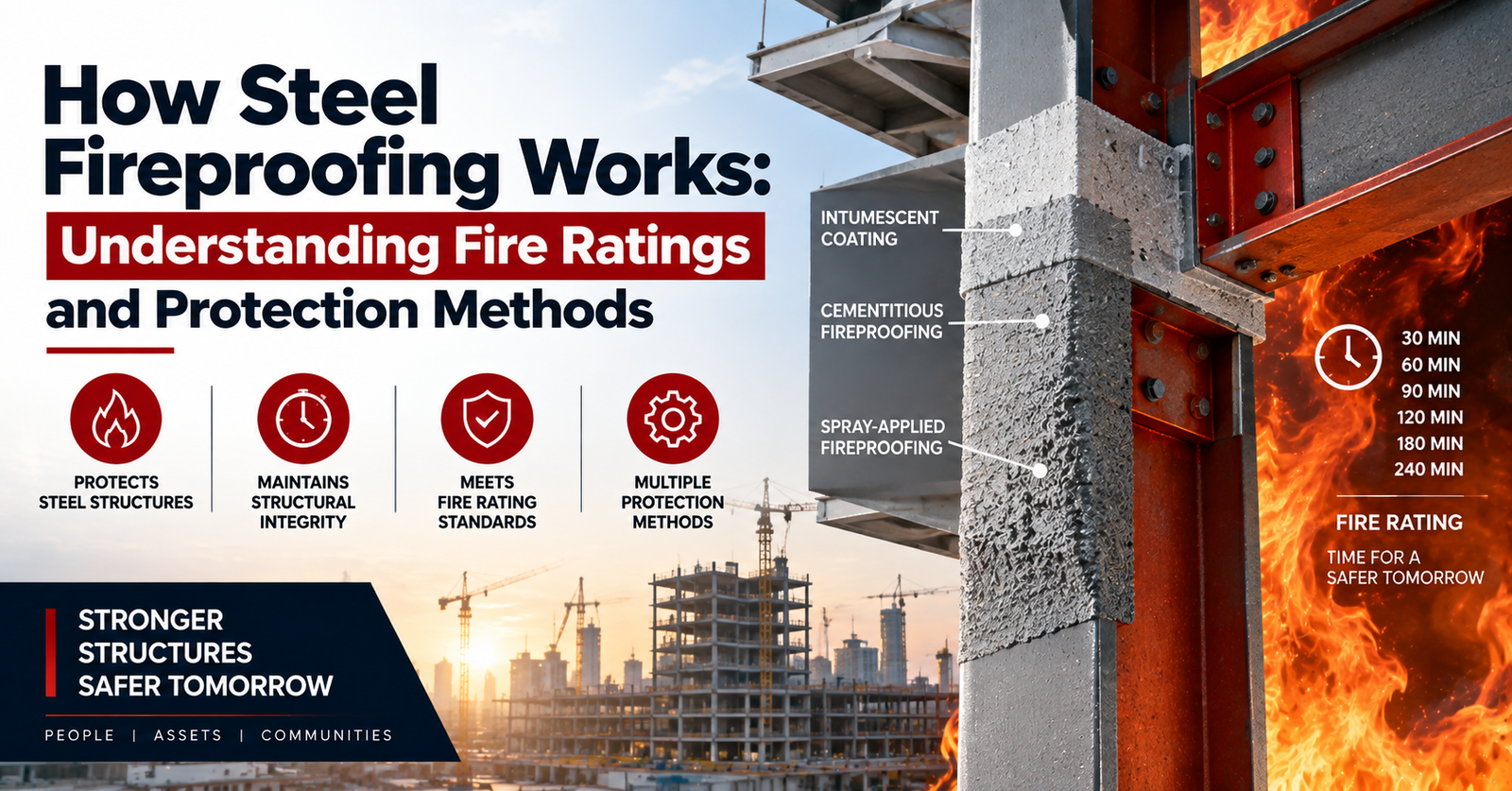
A 60, 90 or 120-minute rating is not a promise the steel survives that long in every fire. It is the tested period a loaded, protected member continues carrying its load under a standard furnace curve before reaching its critical temperature.
Those periods come from ASTM E119 or UL 263 testing. A protected, loaded specimen is heated under a defined temperature-time curve, and the result establishes how much material is needed for a given period.
Two things follow from this.
First, the rating belongs to the tested assembly, not to the tin of product. Applying the same material at a different thickness gives a different result.
Second, the required rating comes from the design, not from the contractor. The fire strategy report and the specification state which members need which rating, based on building type, height, occupancy and the compartmentation strategy. In the Kingdom, SBC 801 sets the underlying requirements, including provisions covering spray-applied and intumescent fire-resistant materials.
The three main protection methods
| Method | What it is | Best suited to |
| Cementitious Fireproofing | Sprayed cement or gypsum-based mortar with lightweight aggregate | Concealed steel, plant rooms, warehouses, car parks |
| Intumescent fireproofing | Thin reactive coating that swells into an insulating char when heated | Exposed architectural steel in lobbies, atriums, retail |
| Board and rigid encasement | Fire-rated boards fixed around the member; or concrete encasement | Columns needing impact resistance, service risers, clean finishes |
Cementitious services work by insulation. The material conducts heat poorly and the bound water absorbs energy as it evaporates. It is cost-effective, fast over large areas, and unapologetically industrial in appearance.
Intumescent fireproofing works chemically. At around 200–250°C the coating reacts and expands many times its applied thickness, forming a carbonaceous char that insulates the steel beneath. Thin when applied, it can be finished to look like paint.
Board and rigid encasement works by physical separation. It gives a clean rectangular finish and resists knocks better than sprayed systems, though it is slower to install around complex connections. Concrete encasement is the traditional version — heavy, but durable and impact-resistant.
Many projects use more than one. Cementitious above the ceiling, intumescent on the feature columns, board around a riser.
Thickness: the part most people underestimate
There is no single thickness for a building.
Required thickness is calculated per member from its section factor, written as Hp/A — heated perimeter divided by cross-sectional area. A slender beam has a high section factor, heats quickly, and needs more material. A heavy column heats slowly and needs less.
The applied result is verified as dry film thickness (DFT), measured after cure and logged per member against the schedule.
One point that deserves emphasis: a member protected to 80% of required thickness does not give 80% of the rating. The relationship is not linear. Assuming otherwise is unsafe, and it is the most consequential shortcut in the trade.
Which method suits your project?
Ask three questions.
Will the steel be seen?
If yes, intumescent or board. If it sits above a ceiling, cementitious is usually the economical answer.
What is the exposure?
Exterior, damp or wash-down areas need an appropriate grade or topcoat. Not every interior product tolerates weather.
What is the programme?
Cementitious covers large areas fast. Intumescent needs recoat intervals observed. The board takes longer around complex connections.
Competent steel fireproofing services in Saudi Arabia will ask these before quoting — not after.
What to ask a contractor
- Is thickness calculated per member from section factor, or one figure across the frame?
- Has primer compatibility been confirmed with the steel fabricator?
- How will DFT be measured and logged?
- Will adhesion and density testing be carried out?
- Which members need a topcoat, and is it in scope?
- Who repairs damage caused by following trades?
- What documentation is handed over at completion?
A steel fireproofing company that answers with specifics has done the work. One that quotes a flat rate without seeing the drawings has not.
Common mistakes
- Treating “fire rated” as a product property rather than a tested assembly
- One thickness across every member regardless of section factor
- Primer compatibility assumed, leading to debonding after erection
- Cementitious Fireproofing specified on exposed architectural steel, then rejected on appearance
- Damage from following trades left unrepaired
- Records assembled at the end instead of collected weekly
Documentation that gets it certified
Civil Defense approval is document-driven. A correct application with no record cannot be signed off. Collect as you go:
- Thickness schedule showing section factor and required thickness per member
- Product data sheets and current third-party listings
- DFT readings logged per member, signed and dated
- Adhesion and density test results where specified
- Photographs before steel is concealed
- Applicator training certificates
Key takeaways
- Steel does not burn; it loses yield strength and then load-bearing capacity
- A fire resistance rating is a tested performance period, not a material property
- Ratings come from the fire strategy report and specification, never from the contractor
- Cementitious, intumescent and board each suit different conditions
- Thickness is calculated per member, and partial thickness does not give partial protection
- Passive fire protection is certified on records as much as on workmanship
Working with Manycon
Manycon provides steel fireproofing across Saudi Arabia from our base in Riyadh — cementitious services, intumescent application and related passive fire protection, alongside firestopping, testing and certification, coatings and construction solutions.
We begin with the thickness schedule and the primer question, because those two decide whether the applied material can be certified later. If you have a steel frame due for protection and want a clear reading of what your specification requires, we can review the documents and arrange a site visit.
Manycon Saudi: +966 56 562 7900 · admin@manyconsaudi.com
Frequently Asked Questions
1. What does a 2-hour fire rating mean?
It means a loaded, protected member continued carrying its design load for two hours under a standard ASTM E119 or UL 263 furnace test before reaching its limiting temperature. It is a tested performance period, not a guarantee for every real fire.
2. At what temperature does steel fail?
Structural steel retains roughly half its yield strength near 550°C, which is commonly treated as the critical temperature for design purposes. Exact limiting temperatures vary with the member and its loading.
3. Which is better — cementitious, intumescent or board?
None is universally better. Cementitious Fireproofing suits concealed and industrial steel. Intumescent fireproofing suits exposed architectural steel. Board and rigid encasement suits members needing a clean finish or impact resistance.
4. Why does each member need a different thickness?
Because thickness derives from section factor (Hp/A). Slender members heat faster and need more material; heavy sections heat slower and need less.
5. How is applied thickness verified?
By measuring dry film thickness after cure at set frequencies, logged per member against the approved thickness schedule.
