


 Fire Proofing Service in Saudi
Two contractors quote the same steel frame. One price is noticeably lower. The lower quote assumes the steel arrives clean, applies a single thickness across every member, and takes readings at the end.
Six months later that job is being reworked, because the material would not bond to the shop primer and nobody could produce a thickness record per member.
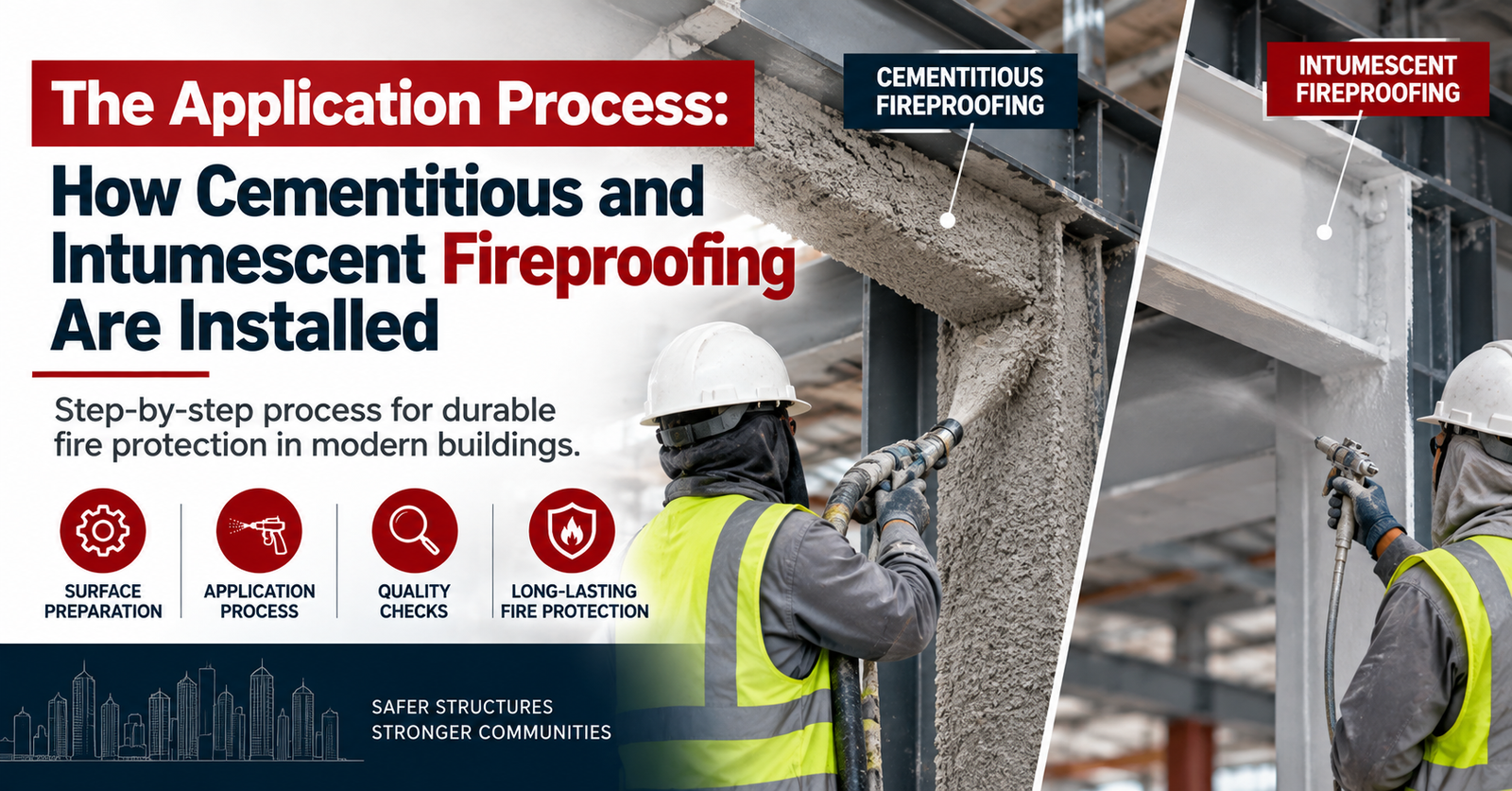
The application process is where fireproofing succeeds or fails. This article walks through how Cementitious Fireproofing and intumescent fireproofing are actually installed, stage by stage, so you know what to expect from an Intumescent and Cementitious Fireproofing company in Saudi Arabia and what to check while the work is in progress.
Stage 1: Before anything is sprayed — shared for both systems
Both systems begin the same way, and this stage decides more than the product choice.
Steel inspection. The frame is checked for oil, grease, loose mill scale, rust and dust. Anything left on the steel becomes a debonding plane later.
Primer compatibility. Not every shop primer accepts fireproofing. Some need a bonding agent, some need keying, some must be removed entirely. Primer compatibility should be confirmed with the fabricator before the steel leaves the shop, not discovered after erection.
Surface preparation. Contamination is removed by cleaning, abrading or blasting to the specified standard. Where primer is incompatible, the affected areas are prepared accordingly.
Access and protection. Scaffolding or MEWPs are set up, and masking is applied to glazing, services, floors and finished surfaces. Overspray on adjacent work is one of the most common sources of dispute on site — proper masking is cheaper than cleaning.
Thickness schedule agreed. Each member’s section factor (Hp/A) and required rating are converted into a required thickness. This schedule is the reference for everything that follows.
Stage 2: Applying cementitious fireproofing
Cementitious services — also called spray applied fire resistive material (SFRM) — follow this sequence:
1. Bonding agent or key coat where the specification or primer condition requires it.
2. Mixing. The dry mortar is mixed with water in controlled proportions. Over-watering to make spraying easier reduces density and strength, and it is a common shortcut.
3. Spray application in passes. Material is applied in successive coats to build thickness. Wet film thickness (WFT) is checked during application with a depth gauge so the crew knows they are on target rather than guessing. On complex sections or where the specification calls for it, mesh reinforcement is embedded to hold thickness on beams, connections and deep sections.
4. Curing, then DFT verification. Once cured, dry film thickness (DFT) is measured at set frequencies and logged per member against the schedule. This is the record an inspector will ask for.
5. Testing and repair. Where specified, bond strength is confirmed by an adhesion test, and density is verified. Any thin areas, damage or missed sections are made good and re-measured.
6. Topcoat or sealer where the environment requires it — exposed or damp locations especially.
Stage 3: Applying intumescent fireproofing
Intumescent fireproofing is applied like a paint system, but the discipline is closer to a coating specification than to decorating.
1. Blast or prepare to the specified standard. Intumescent is less forgiving of surface contamination than cementitious.
2. Compatible primer. Either the approved shop primer, verified as compatible, or a specified primer applied on site.
3. Basecoat application. The intumescent basecoat is applied by airless spray, usually across several passes with recoat intervals observed between them. Applying the next coat too early traps solvent and causes blistering. Wet film thickness is checked continuously, because once cured the material cannot simply be topped up without preparation.
4. Cure and DFT check. After cure, dry film thickness is measured per member against the schedule derived from section factor. Readings are logged, not estimated.
5. Sealer coat or decorative topcoat. A topcoat is applied where appearance or exposure requires it. It must be a system the intumescent manufacturer approves — an unapproved topcoat can restrict the material’s expansion in a fire.
6. Snagging and repairing. Damage from following trades is repaired to specification and recorded.
What Saudi site conditions change
Ambient and substrate temperature. High surface temperatures affect cure, flash-off and film build for both systems. Steel sitting in direct sun can be far hotter than air temperature — measure it rather than assuming.
Recoat intervals shift. Heat shortens some intervals and complicates others. Follow the data sheet for the actual measured conditions, not the standard figure.
Humidity and ventilation. Enclosed areas need controlled ventilation for cure quality and for worker safety.
Working hours. Programs often move spraying to early morning. Plan for it rather than absorbing it as lost time.
Dust. Airborne sand settling on a wet film is a real defect risk. Screening matters.
What to ask while the work is running
- Has primer compatibility been confirmed in writing with the fabricator?
- Is thickness calculated per member from section factor, or one figure across the frame?
- What WFT checking method is the crew using during application?
- How often is DFT measured, and can we see the log per member?
- Will adhesion and density testing be carried out?
- What are the recorded ambient and substrate temperature conditions on spray days?
- Who repairs damage caused by following trades, and is it in the contract?
Common mistakes
- Primer compatibility assumed rather than confirmed
- Over-watered mix on cementitious, reducing density
- Ignoring recoat intervals on intumescent, causing blistering
- No wet film thickness checks, so problems are only found after cure
- One thickness applied across all members regardless of section factor
- Poor masking, resulting in overspray damage and disputes
- Unapproved topcoat over intumescent, restricting expansion
- Surface preparation rushed to recover programme
Documentation to collect as you go
SBC 801 sets the technical requirements and Civil Defense records are what get the work certified. Collect weekly:
- Thickness schedule with section factor per member
- WFT and DFT logs, signed and dated
- Product data sheets and current listings
- Adhesion and density test results
- Ambient and substrate temperature records on spray days
- Photographs before steel is concealed
- Applicator training certificates
Key takeaways
- Preparation and primer decide bond; product choice decides finish
- Cementitious builds thickness in passes; intumescent builds film in coats
- WFT during application prevents problems that DFT only reveals afterwards
- Thickness is per member, never one figure for the frame
- Saudi heat changes cure and recoat behaviour — measure, do not assume
- Records collected weekly are the difference between certified and reworked
Working with Manycon
Manycon provides fireproofing and cementitious services alongside intumescent application across Saudi Arabia, from our base in Riyadh, together with firestopping, testing and certification, coatings, waterproofing and construction solutions.
We start with the primer question and the thickness schedule, because those two determine whether the applied material can be certified later. If you have a steel frame due for protection, we can review the specification with you and arrange a site visit.
Manycon Saudi : +966 56 562 7900 · admin@manyconsaudi.com
Frequently Asked Questions
1. How is cementitious fireproofing applied?
Cementitious Fireproofing, or SFRM, is mixed with water and spray-applied in successive passes onto prepared steel, sometimes with mesh reinforcement, then cured and verified by thickness measurement per member.
2. When is mesh reinforcement needed?
Mesh reinforcement is used where the specification requires it or where thickness must be held on deep sections, beams and connections that would otherwise be difficult to build up reliably.
3. How is intumescent fireproofing applied?
Intumescent fireproofing is airless-sprayed as a basecoat over a compatible primer, in several passes with recoat intervals observed, then cured, thickness-verified and finished with an approved sealer or decorative topcoat.
4. Why does each steel member need a different thickness?
Because thickness derives from section factor (Hp/A). Slender members heat faster and need more protection; heavy sections heat more slowly and need less.
5. What is the difference between WFT and DFT?
Wet film thickness is measured during application so the crew can correct in real time. Dry film thickness is measured after cure and is the value recorded for compliance.
