


 Fire Proofing Service in Saudi
A building can have every sprinkler head, every detector and a fully commissioned alarm panel — and still lose a fire to the floor above in under ten minutes.
The reason is usually invisible. Above the ceiling, where cables and pipes cross from one room to the next, the holes through the fire-rated walls were never properly sealed. Fire and smoke simply walked through them.
This is the part of fire protection nobody photographs for the handover album, and it is the part that most often gets a building held up at Civil Defense inspection. Before you appoint a fire protection company in Saudi Arabia, it is worth understanding what this work actually involves.
Two halves of fire protection, and only one gets noticed
Active fire protection reacts to fire. Detectors sense it, alarms warn people, sprinklers and gas systems fight it. These need power, water or a signal to function.
Passive fire protection does not react to anything. It is built into the structure and works simply because it is there. It keeps fire inside the room where it started and keeps the steel standing while people leave.
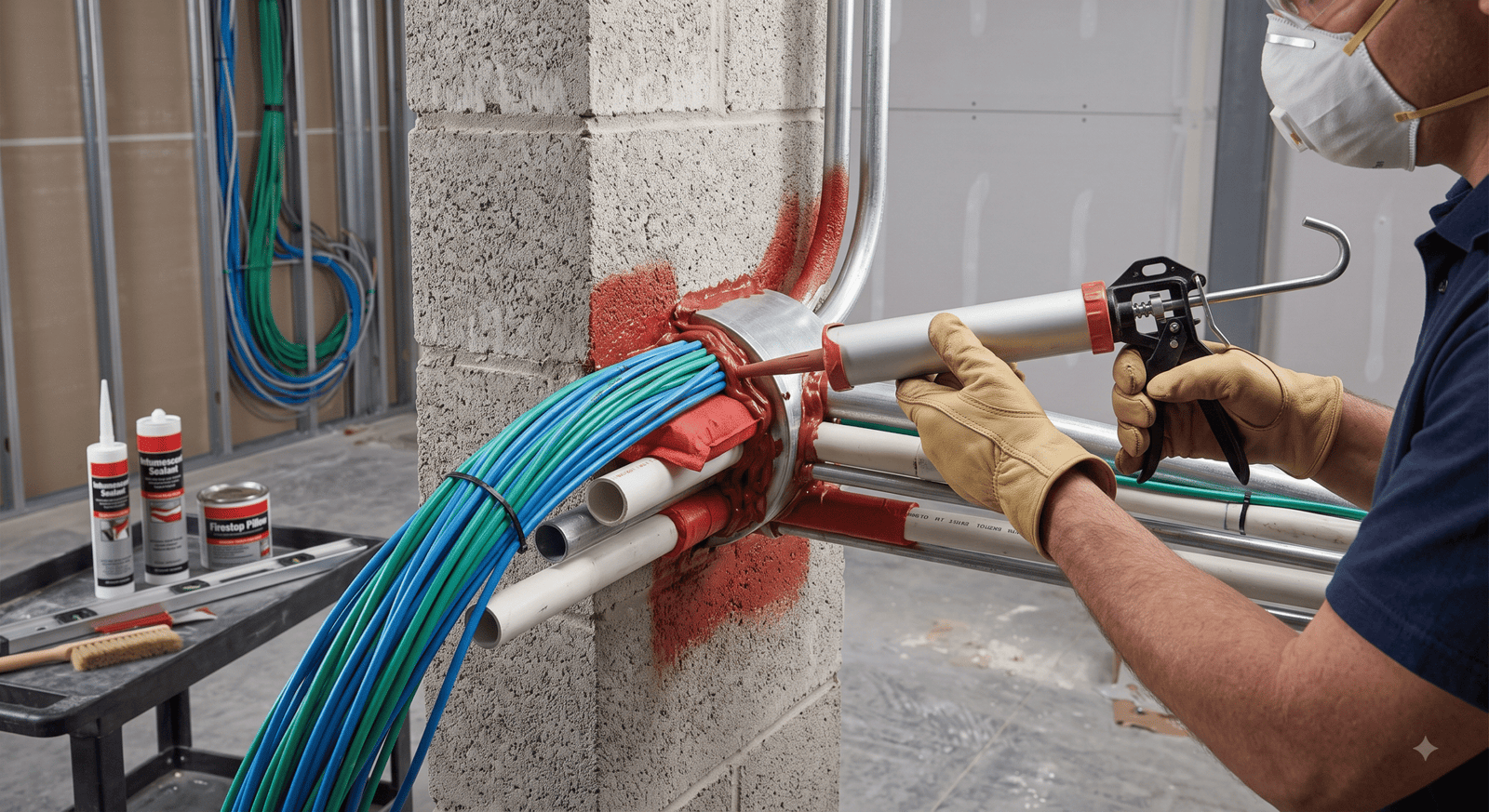
Firestopping is the core of that passive half — sealing every opening where a service crosses a fire-rated wall or floor, so the barrier performs as the drawings claim.
Both halves matter. But if the compartment fails, sprinklers are fighting a much larger fire than they were designed for. Good fire protection services cover both — not only the equipment you can see.
Why sealed walls matter more than most people assume
A fire-rated wall is only rated if it is continuous. Every hole reduces it.
Think about how many holes there actually are. Electrical containment, data cabling, chilled water pipes, drainage, fire alarm loops, ducts — each one crosses walls and slabs repeatedly. On a mid-sized building that is hundreds of penetrations, sometimes thousands.
Miss a percentage of them and smoke travels through the ceiling void into corridors and stairwells. Smoke, not flame, is what stops people escaping.
The mistake that costs projects the most
There is a sentence heard on almost every site: “We used fire-rated sealant, so it’s fine.”
It usually is not.
A firestop sealant does not carry a rating by itself. The rating belongs to a complete tested system — the wall type, the item passing through it, the size of the gap, the depth of material, and the backing behind it, all tested together in a furnace. Change one variable and the test result no longer applies.
A tested arrangement for a steel pipe through a concrete slab does not cover a PVC pipe through the same slab. PVC melts and vanishes early in a fire, leaving an open hole, so it needs an intumescent collar that closes the gap as the pipe disappears. Steel keeps its shape but conducts heat. Same hole, entirely different solution.
Using one sealant everywhere looks complete when the ceiling closes. It cannot be certified.
In Saudi Arabia, proof matters as much as installation
Fire safety approval runs through the General Directorate of Civil Defense and its Salamah platform, with SBC 801 setting the technical requirements. The process is document-driven.
An inspector effectively asks four questions about any seal: what was installed, where, by whom, and to which tested system. A perfect installation with no record behind it still cannot be signed off.
That means the work needs a penetration schedule, product listings, trained installer certificates, dated photographs taken before ceilings close, and a label on each completed seal. Built weekly as the work proceeds, this is routine. Reconstructed in the final fortnight, it rarely holds — and that is where handover dates slip.
What to check before appointing a contractor
Six questions separate a genuine fire protection company in Saudi Arabia from a subcontractor with a caulking gun:
- Which tested system will you use for each condition on our project? (Specialists answer with listing references, not brand names.)
- Are your installers manufacturer-trained, and can we see certificates?
- What does your inspection record look like? Can we see a sample?
- How will you handle penetrations created after sign-off?
- Will every seal be labelled and photographed?
- What documentation will we receive at handover?
Vague answers to these are the clearest warning sign available.
Common mistakes worth avoiding
- Treating firestopping as a snagging item instead of an engineering scope
- One product used across every condition on site
- Cables added to a completed seal without reinstating it
- Blank sleeves left unsealed for “future use”
- Curtain wall perimeter and head-of-wall joints overlooked entirely
- No photographs taken before ceilings closed
Key takeaways
- Firestopping restores the fire rating of walls and floors that services pass through
- Ratings belong to tested systems, not to products
- Different penetrating materials need different solutions in the same wall
- Civil Defense approval depends on documentation as much as workmanship
- Passive protection needs maintaining — every later penetration must be reinstated
- Involving a specialist early costs far less than correcting work after ceilings close
Where Manycon fits
Manycon is a fire protection company in Saudi Arabia delivering firestopping and passive fire protection from our base in Riyadh, alongside structural fireproofing, testing and certification, coatings, waterproofing and construction solutions.
We start with a penetration survey and a system schedule, because that determines whether anything installed afterwards can actually be certified. If you have a live project and want to know where the gaps are before an inspector finds them, we can carry out a site survey and advise.
Manycon Saudi : +966 56 562 7900 · admin@manyconsaudi.com
Frequently Asked Questions
What is firestopping?
Firestopping seals openings and joints in fire-rated walls and floors where cables, pipes, ducts and trays pass through, so the barrier’s fire resistance is restored and fire and smoke cannot spread between compartments.
Is firestopping mandatory in Saudi Arabia?
Yes. Fire-rated construction and the protection of penetrations through it are required under the Saudi Building Code fire provisions and enforced by the General Directorate of Civil Defense.
Why isn’t fire-rated sealant on its own enough?
Because the rating belongs to a tested system, not the product. The listing specifies the barrier, the penetrating item, the gap size, the material depth and the backing. If the installation does not match a tested arrangement, there is no rating to claim.
Can the same firestop material be used for every penetration?
No. A steel pipe, a PVC pipe, a cable bundle and a cable tray each require different listed systems, even in the same wall.
What happens if a cable is pulled through a finished seal?
The seal is void at that point and must be reinstated to a listed system. This is why a permit-to-penetrate procedure should run from first fix through to handover.
