


 Room Integrity Testing in Saudi Arabia
Walk into almost any major facility Room integrity testing in Saudi Arabia today — a bank, a hospital, a data center, an airport — and somewhere inside that building, there is a room that has been fitted with a gaseous fire suppression system. It might be a server room. It might be an electrical control room or a pharmaceutical storage vault. The specifics vary. What does not vary is the expectation attached to that system — that when a fire breaks out, the suppression agent will be released, fill the space, and extinguish the fire before serious damage is done.
Here is the part that tends to get overlooked.
A suppression system being installed does not automatically mean it will work. The room itself has to be capable of holding the agent at the right concentration for long enough to actually suppress the fire. If the walls, floor, cable penetrations, or door seals are not airtight enough, the agent leaks out within minutes — and the fire continues.
Room integrity testing is the process through which that question gets answered. It is not optional paperwork. It is a practical verification exercise, and in Saudi Arabia, it is increasingly being enforced across a broad range of industries.
This blog walks through the sectors where this testing is required, what makes it particularly important in each one, and what tends to happen when it is treated as a low priority.
A Quick Look at How the Test Works
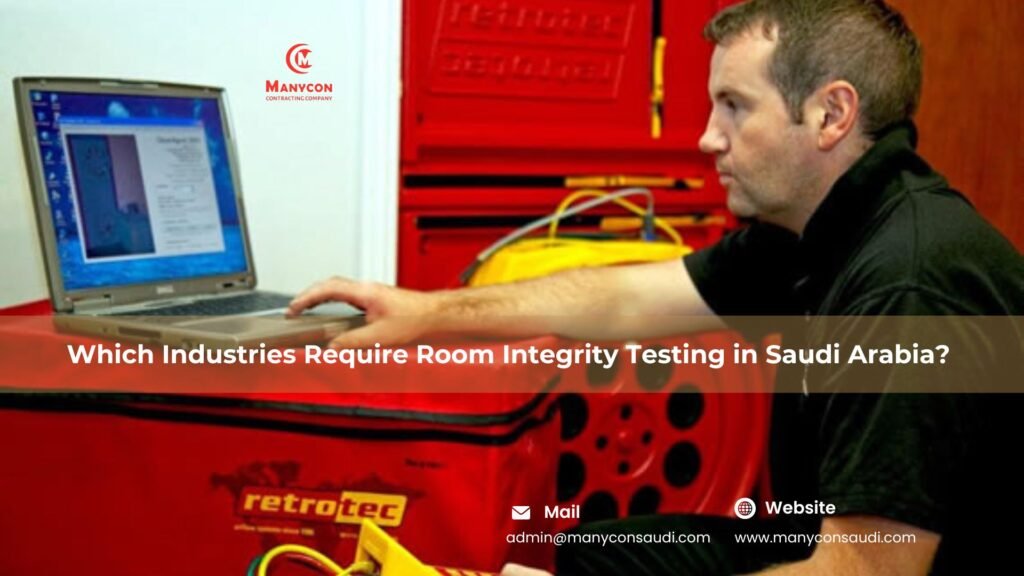
A calibrated fan is fitted into the doorframe of the protected space. The room is pressurized and depressurized in a controlled sequence, and the pressure readings collected during that process are used to calculate how quickly air — and therefore gas — escapes from the enclosure.
From that data, it becomes possible to determine whether the suppression agent, once discharged, would remain at the required concentration for the minimum retention period — generally accepted as ten minutes under NFPA 2001 and ISO 14520, the two standards most widely referenced in Saudi Arabia alongside guidance issued by the Saudi Civil Defense Authority (SCDA).
A room that passes holds its gas long enough for the fire to be dealt with. A Room integrity testing that fails needs sealing work done and must be retested. Simple in concept, but frequently neglected in practice.
Data Centers and IT Server Rooms
Saudi Arabia’s data infrastructure has expanded at a rate that caught many people off guard. Government cloud platforms, private enterprise server rooms, and hyperscale facilities are now spread across Riyadh, Jeddah, Dammam, and increasingly into the NEOM development corridor.
Every one of these facilities depends on a clean agent suppression system. Water anywhere near active server hardware is not a viable option — a sprinkler activation would likely cause more damage than the fire it was meant to stop. FM-200, Novec 1230, and inert gas blends are used instead, and for any of these to function as intended, the room they are installed in has to pass a room integrity test.
New cable routes, equipment swaps, and minor construction work all create fresh leakage points over time. A room that passed its test two years ago may not pass today, which is why periodic retesting is built into the compliance requirements for this sector.
Oil, Gas, and Energy Facilities
Saudi Arabia’s energy infrastructure remains the foundation of its economy, and within that infrastructure, there are thousands of enclosed spaces — control rooms, relay panel rooms, SCADA enclosures — where water suppression cannot be used and where equipment failure has consequences that extend far beyond the immediate facility.
Gaseous suppression is the standard approach in these environments. Room integrity testing is required to confirm that the rooms housing this suppression infrastructure are actually capable of retaining the agent. It is a requirement that tends to be taken seriously in this sector, partly because the SCDA enforces it and partly because the cost of getting it wrong is well understood by the people responsible for these facilities.
Banks and Financial Institutions
Saudi Arabia’s banking sector has moved quickly through a period of digital transformation. Core banking systems, transaction processing environments, and customer data infrastructure are now housed in dedicated server rooms and data centers managed either in-house or through third-party providers.
These environments require clean agent suppression, and the documentation attached to that suppression infrastructure — including room integrity test certificates — is reviewed regularly during internal audits, SAMA-related compliance checks, and assessments linked to international data security frameworks. Facilities where this paperwork is missing or out of date tend to find themselves fielding difficult questions from auditors who are not particularly interested in explanations.
Hospitals and Pharmaceutical Manufacturers
Healthcare facilities across Saudi Arabia manage a range of sensitive enclosed environments — server rooms, radiology suites, laboratory control areas, and pharmaceutical storage spaces — where water suppression would cause the kind of damage that takes months to recover from.
Pharmaceutical manufacturers face an additional layer of scrutiny. Good Manufacturing Practice audits examine fire suppression documentation as part of a broader review of facility compliance. Room integrity test certificates are expected to be present, accurate, and current. Facilities that cannot produce them during an audit face consequences that go beyond a simple compliance note.
Telecom and Network Infrastructure
The rollout of 5G networks, national broadband expansion, and the integration of smart city technology across Saudi Arabia has significantly increased the number of critical equipment rooms being operated by telecom providers and network operators.
These rooms contain hardware that is both costly and difficult to replace quickly. Gaseous suppression systems are installed as a matter of course, and Room integrity testing is required to ensure those systems remain effective as facilities are upgraded and expanded over time. For operators working under national license conditions, this is a compliance requirement that cannot be quietly set aside.
Airports and Aviation Facilities
Saudi Arabia’s aviation sector is mid-expansion. New terminals are being commissioned, regional airports are being upgraded, and purpose-built aviation hubs are in various stages of development. Inside these facilities, air traffic control rooms, server centers, maintenance hangars, and baggage system control enclosures all rely on gaseous suppression.
ICAO standards, domestic aviation authority requirements, and the insurance conditions attached to aviation facility operations all point toward the same expectation —Room integrity testing must be conducted, the results must be documented, and that documentation must be kept available for review.
Manufacturing and Industrial Sites
Electronics production, defense manufacturing, automotive assembly, and chemical processing all involve enclosed control environments where expensive and sensitive equipment is operated. These rooms are typically fitted with gaseous suppression systems, and Room integrity testing is the mechanism through which the reliability of that protection is confirmed.
Facilities in this sector that have not conducted testing within the required timeframe are frequently found — during audits or insurance assessments — to have suppression systems that would underperform during an actual emergency. That discovery is considerably less disruptive during an audit than during a fire.
Museums, Archives, and Heritage Sites
Saudi Arabia’s Room integrity testing cultural development ambitions have resulted in world-class museum projects, national archive facilities, and heritage conservation sites being established across AlUla, Diriyah, and Riyadh. The collections housed within these buildings — historical documents, archaeological artifacts, irreplaceable cultural objects — cannot be protected by water-based systems.
Clean agent suppression is the only appropriate choice, and room integrity testing is required to ensure those systems will actually hold the suppression agent when a fire breaks out. The consequences of failure here are permanent in a way that goes beyond financial loss.
What Non-Compliance Actually Looks Like
Facilities that cannot produce valid room integrity test documentation when the SCDA comes to inspect face a straightforward set of consequences — penalties, potential operational suspension, and insurance complications that tend to surface at the worst possible moment.
Beyond the regulatory angle, there is a more immediate concern. A suppression system installed in a room that has never been integrity tested may simply not work during a real fire event. The system activates, the agent discharges, and it leaks out through unsealed penetrations before the fire has been dealt with. The system did what it was supposed to do. The room did not.
Conclusion
Room integrity testing sits at the intersection of practical fire safety and regulatory compliance, and it applies across a wider range of industries in Saudi Arabia than many facility managers initially expect. Data centers, energy facilities, banks, hospitals, telecoms providers, airports, manufacturers, and cultural institutions all have a genuine requirement to conduct and document this testing.
Manycon works with businesses across Room integrity testing in Saudi Arabia and the wider GCC region to get fire safety documentation handled quickly and correctly. Compliance paperwork that might otherwise take weeks to navigate is processed efficiently, leaving operations teams free to focus on what they are actually there to do. That is the straightforward value Manycon brings to the table — fast, reliable documentation support for businesses that cannot afford to wait.
